Twitter, Tourettes, and Tribalism
My unsolicited opinions from the intersection (and why my identity shouldn't be hailed as a panacea!)

Definitions:
Pathology.
Used attributively and in the possessive (esp. in Tourette(’s) syndrome) to designate a neurological disorder characterized by tics, involuntary vocalization, and the compulsive utterance of obscenities. Also elliptical as Tourette(’s).
Intense loyalty to one’s own community or group; strong identification with a particular group, often involving the exclusion or rejection of those who are not members of the group.
I twitch too much to sleep. This, along with a variety of other factors, makes uninterrupted rest a rarity for me. My nights are often spent frustratedly dancing around the stillness, nearly always missing the mark. When it becomes clear that sleep is not in the cards for a night, I tend to fill my nocturnal hours in other ways; walking, reading, writing (as I am now), and most unfortunately, doomscrolling. This last pastime is where I discovered a dispute that can only be described as rage-bait, yet it’s managed to occupy a pointlessly large chunk of my waking thoughts. Online short-form discourse has never and should never be known for thoughtful takes constructed with nuance and care. However, when it comes to the BAFTAs, any semblance of common sense seems to have flown out the window.
The situation unfolded as follows: In the BBC-aired BAFTA awards show, Michael B. Jordan and Delroy Lindo, two prominent Black American figures in entertainment, were presenting awards. John Davidson — Scottish BAFTA nominee and Tourette’s Syndrome advocate — then ticced the word “Nigger”. Loudly. On nationally broadcast television. One would think this was cooked up as a Tumblr fantasy. It “tics” every box to elicit some of the worst online discourse known to mankind (allow me my painfully bad humor; without it I have nothing).
The response has been a hyper-simplified understanding of the situation that swings one of two ways: either a solely race-based approach that lacks a basic understanding of TS as a neurological disorder, or one that minimizes the significance of the slur to needlessly defend Davidson. There’s also, of course, the quintessential Twitter approach: hunting down individuals who belong to an intersection of the two communities, and cherry-picking takes to put on the “Listen and Learn” pedestal.
Before exploring these takes, some background is in order: Who are the players in this whole ordeal?
We’ll start with MBJ and Delroy Lindo: Two respected Black actors coming off of the immense and deserved success of Coogler’s Sinners, a movie that specifically interacts with themes of systemic oppression, exploitation of Black culture, and communal memory (the irony should not be lost here). They’ve faced a disproportionate amount of criticism and scrutiny, especially when compared to the relative receptions of other objectively less successful movies. If you haven’t seen it, go watch it.
Next, Davidson: The working-class, disabled, white man embroiled in the center of this mess. He suffers from coprolalia, a symptom defined by the Tourette Association of America as “the involuntary outburst of obscene words or socially inappropriate and derogatory remarks”. He was present at the BAFTAs to celebrate the nomination of the movie I Swear, a biopic that details his experiences living with TS and the discrimination that comes with it. Again, if you haven’t seen it, go watch it.
Lastly, BBC One: The broadcasting company that ensured the coverage of this incident. It is important to note that the BAFTAs are aired with a delay to allow for edits; a detail that makes BBC’s apologies feel especially empty. To add insult to injury, the company proved its capabilities in editing BAFTA footage by completely removing the pro-Palestine and anti-genocide sentiments from Akinola Davies Jr.'s acceptance speech. That leaves the question: why did the racial slur remain? And why was Davidson sat in such close proximity to a microphone?
With the three parties identified, let’s transition to the responses. Understandably, many Black individuals were and are angry. I would like to take a moment to note that I do not seek to police this anger out of existence. The history of the N-word is a long and painful one, and it would be foolish to expect its impact to magically disappear. However, I do think some redirection is in order. For example:
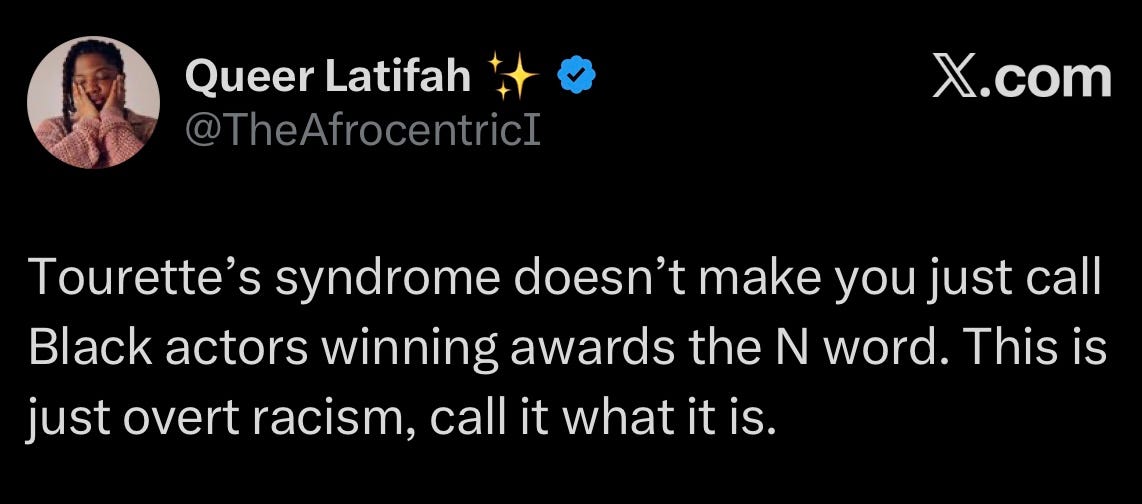
The sad truth? Tourette’s can make you do exactly that, and much more. Coprophenomena are dangerous, humiliating, and isolating for those who experience them. And as a result? The TAA reports that 72% of those of us diagnosed with TS have considered suicide at some point in our lives. Even worse, 38% or more than 1 in 4 have attempted in the past twelve months. Those numbers make Dean Cole's comments at the NAACP Image Awards even more uncomfortable:
“Lord, before we go, if there are any white men out here in the audience with Tourette’s, I advise you to tell them they better read the room tonight, Lord. It might not go the way they thinketh. Whatever medicine they’re on, they better double up on it, Lord”.
People are understandably upset — A white man shouted “Nigger” at two Black men on national television. The only problem? Responses are coming from a place of ignorance. People have begun to demand that individuals with coprophenomena medicate themselves, muzzle themselves, and even completely self-isolate, to avoid harming BIPOC communities unintentionally. We’re backsliding when it comes to core tenets of the U.S. Disability Rights Movement (Which by the way, was built on the foundation of the Civil Rights Movement!). The conflict seems to have transformed into a tribalistic “us vs. them” divide; the ones centering Black rights, and the ones centering disability rights. The second camp has unfortunately also been used as an excuse to regurgitate some iconic racist talking points:
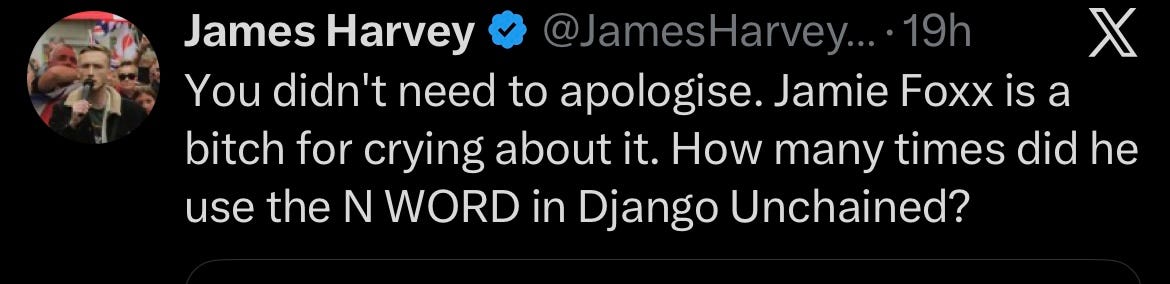
The logic: Black people who use the N-word are hypocrites and have no right to react negatively when white people use it. Heard that before?
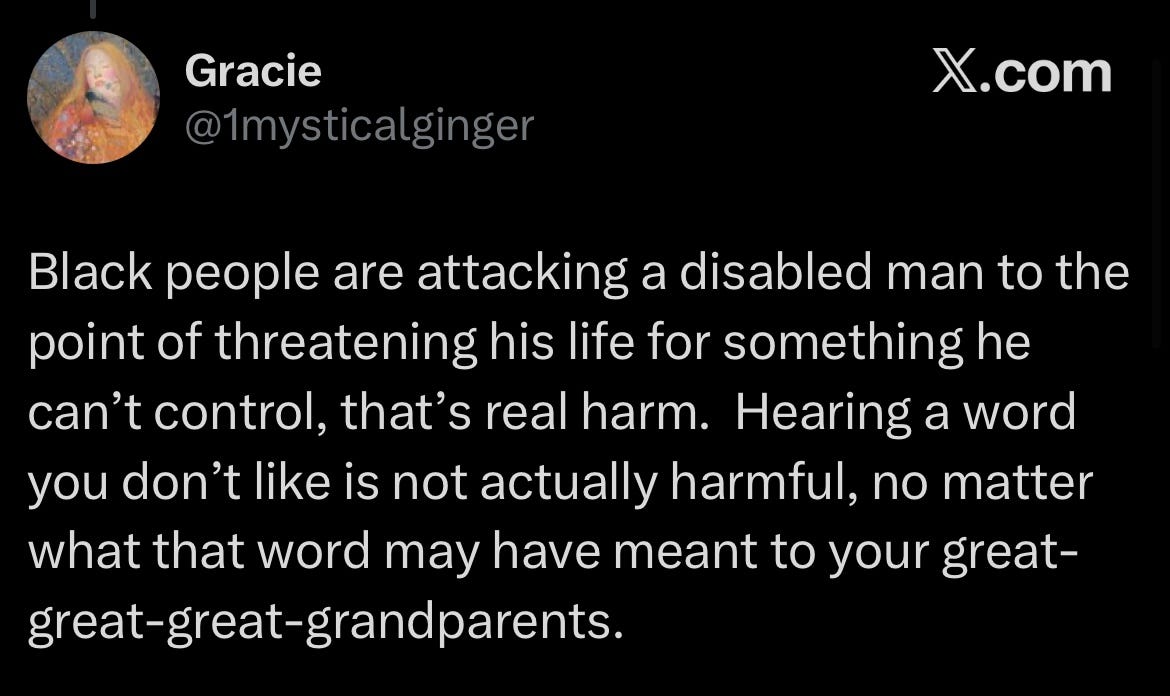
The use of the N-word is no longer harmful. We’re too far divorced from when it “actually meant something”. Yikes. It’s like I’m in high school again.
I, predictably, am riding the fence on this one. It’s not like I’m about to deny one key part of my identity for another. I’m firstly glad that Davidson apologized for the impact of the event. It hurt people, and he recognizes that. I’m also extremely thankful that he remains unapologetic regarding his disability, and hope he remains that way. I think that people have a right to be upset, but I’m also infuriated that the general public is so misinformed regarding TS. I believe the real evil here is BBC. They took an evening with the potential for inclusion and turned it into a spectacle, giving opportunity to gawk at a disabled individual like a sideshow freak while also allowing for mass scrutiny of Black individuals and downplaying of Black pain. Their choices disgust me.
The thing is, you don’t have to care what I think! Yes, I’m pretentious enough to write about it, and yes, I exist in the inseparable intersection of two groups that are being pushed apart. My lived experience does give me perspective. However, there’s been a bad habit in the last few years of using purely the identities of various individuals to elevate specific convenient talking points but look “morally pure” while doing so. The actual validity of the takes is then relegated to the back burner. This has created a ladder of identities to climb until one nears a platonic ideal of “wokeness” and is handed a microphone. If you’re the only Black person in the room, the only disabled person in the room, the only “properly marginalized” individual in a room full of liberals, trust that your voice will be sought to validate everyone’s opinion. On everything.
The issues with saying “this person is [x], so shut up, listen and learn” are that communities are not monoliths, and the people within them are not all perfectly educated and willing teachers absolved of all criticism. I’ve seen that there are Black people that disagree with me and people with TS that disagree with me. I’m even sure that there are other Black people with TS who likely disagree with me. And they might all be right. At the end of the day, I’m one person whose voice shouldn’t be amplified or expected solely because of the labels I can claim. The push for marginalized individuals to offer their opinions as a panacea to all related discourse is a fool’s errand and presumes that we want to get involved. The “listen and learn” mindset assumes a desire to speak and to teach. It shifts the responsibility of well-developed takes and burden of education onto those that often did not ask for it.
Except I did. I just like to yap.
Also, Twitter discourse doesn’t actually matter. Go volunteer somewhere and read the news. Vote in your local elections. Do something productive with your time.